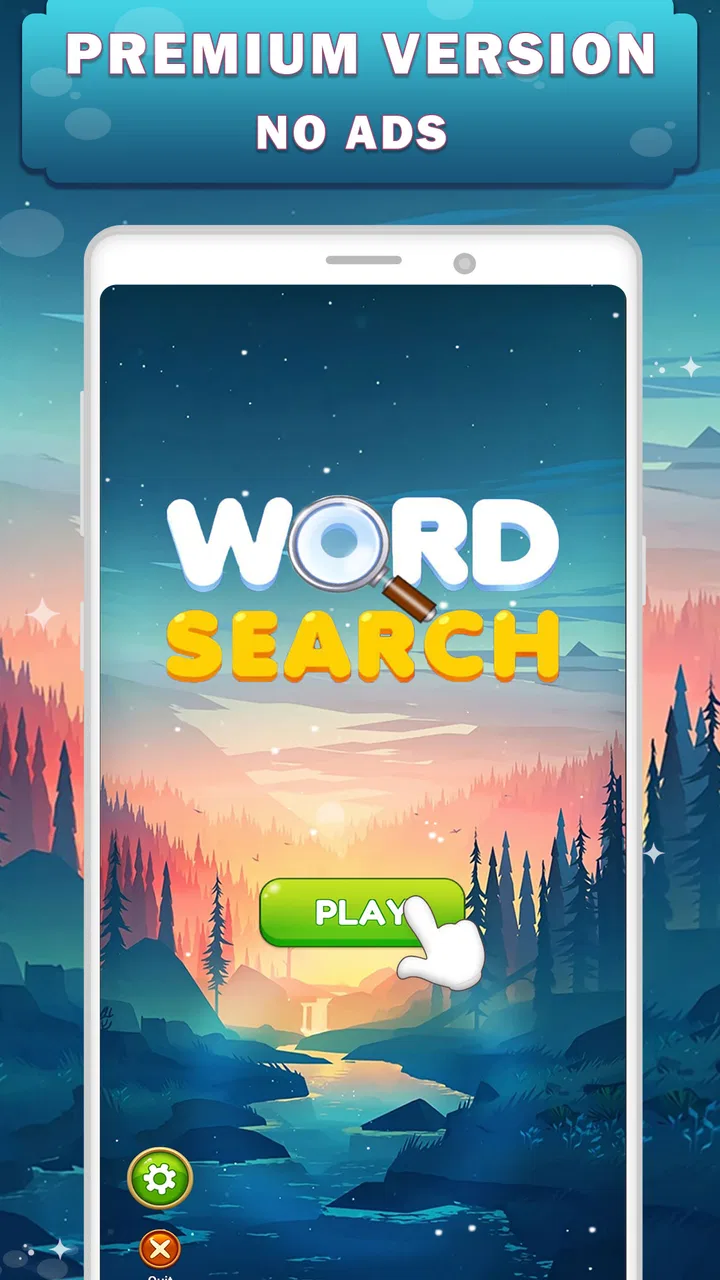
Word Search Game: Offline
- 4.6
- Rating
- 10.00K
- Installs
- $1.99
- Price
 Analysis by App-foxy
I spent time with Word Search Game: Offline as a simple word puzzle rather than treating it like a large, feature-heavy mobile game. That distinction matters. This is a focused word-search title from otto games, built around the familiar pleasure of scanning a letter grid, spotting hidden words, and keeping your attention occupied for a while. It is not trying to replace a full puzzle collection, and I think its appeal depends on whether that narrow experience matches what you want from your phone.
The basic idea is immediately approachable: look through a grid and find the listed words. There is no steep learning curve, complicated rulebook, or specialist vocabulary needed before starting. The store describes it as suitable for hours of entertainment, and I can understand that positioning because word searches are easy to pick up in short sessions but can also become absorbing when a final word refuses to reveal itself. The important question is not whether the concept is original; it is whether this particular implementation gives you enough value for the way you play.
What the game offers and what you are paying for
The game sits in the word puzzle category and is aimed at a broad audience. Its content rating is Everyone, which makes it a reasonable choice for households looking for a calm puzzle that does not depend on mature themes or fast reactions. I would still treat it as an individual puzzle experience rather than assuming every child will find the grids equally comfortable, since reading ability and patience naturally affect how enjoyable a word search feels.
You May Also Like

 Pandora - Music & Podcasts
Pandora’s Music Is Easy to Start, but Harder to Recover
Pandora’s strength is its low-effort path from a seed to a station. Its weak spot is how much confidence it asks you to place in connection, setup, and quiet recovery.

 8 Ball Pool
 Is Built on Rivalries, Rematches, and Routine
A close look at the rivalries, rematches, shared routines, and unanswered safety questions that turn a quick pool match into a persistent mobile community.

 Samsung Music
’s Quiet Strength Is Playing What You Already Own
Its reach comes less from spectacle than from dependable access to a personal library. That simplicity is both the app’s strongest retention engine and its ceiling.

 AccuWeather: Weather Radar
AccuWeather Review: A Quick, Clear Forecast for Everyday Decisions
For everyday plans, the best forecast is the one you can understand quickly. AccuWeather makes rain timing, radar, and local conditions easy to act on, with a few trade-offs.

 Hill Climb Racing
Why Hill Climb Racing Still Turns Crashes Into One More Run
A tiny car, a bumpy hill and one more upgrade: Hill Climb Racing keeps resurfacing because its simple chaos makes every near-miss feel personal.

 AliExpress - Shopping App
AliExpress Makes Global Shopping Feel Personal, but Shoppers Bear the Risk
AliExpress turns a global marketplace into a pocket-sized discovery engine. Its reach is useful, its shopping loop compelling, and its trade-offs easy to miss.
More From Our News Desk
View All News


There is a clear purchase cost: the game is listed at $1.99. That makes the value question different from evaluating a completely free download supported by advertising. You are making a small upfront commitment, so the right comparison is with other inexpensive puzzle games and with the amount of use you expect to get from a straightforward word-search format. In-app purchases are also listed, ranging from $0.99 to $3.99 per item. I would check the purchase screen carefully before confirming anything, especially if the phone is shared with younger players.
That pricing structure creates a practical trade-off. The initial price is low enough to make the game accessible, but it means the experience needs to feel comfortable and repeatable rather than merely interesting for a few minutes. If you already know that you enjoy traditional word searches, the entry cost is easier to justify. If you are only curious about the format, a free alternative may be a safer first test, provided you are willing to tolerate advertising or a different presentation.
The game reached the store on May 15, 2022, and the current version is 2.6. It runs on Android 7.0 or later, so compatibility should cover many older devices as well as newer ones. I see that as useful for people who keep a secondary phone for travel, relaxation, or a family member, although the exact feel will still depend on screen size and how comfortably you can distinguish letters on that particular display.
Its public reception is encouraging without being a reason to skip your own evaluation. It has a 4.6 average from around 675 ratings and roughly 123 written reviews, with more than 10K installs. Those figures suggest that the focused concept works for a meaningful group of players, but they do not tell me whether the game suits your preferred difficulty, visual style, or tolerance for optional spending. I would read that reception as a useful signal, not a substitute for understanding the format.
The first-session experience
What I like most about this kind of game is how little preparation it demands. I can open it when I have a few spare minutes, understand the task immediately, and start searching without building a strategy around timers, lives, or complex progression. That makes it a good companion for a quiet break, a waiting room, or the end of the evening when I want something more active than scrolling but less demanding than a competitive game.
The central skill is visual scanning. I tend to begin by looking for unusual letter combinations or the first and last letters of a target word, then trace possible directions through the grid. When a puzzle becomes difficult, I stop trying to inspect every row equally and instead divide the board into smaller zones. That simple change prevents the familiar problem of repeatedly searching the same area while overlooking an answer near the edge.
A useful everyday scenario is a short commute as a passenger. I can play one puzzle without needing sound, a stable social connection, or a long uninterrupted session. The same quality works for someone who wants a gentle mental activity during a coffee break. It is also suitable for a parent who wants a quiet game to share with a child, because the rules can be explained in moments and the activity encourages careful reading rather than rapid tapping.
For older players, the appeal is similarly direct. A word search can feel more purposeful than an endless stream of casual content, while remaining less intimidating than a crossword or a puzzle that expects broad general knowledge. The game does not require me to remember a large set of clues or calculate a route. I simply work through the visible letters, which keeps the mental load focused and understandable.
Small habits that make the format more enjoyable
My first practical tip is to change the way you search instead of increasing speed. I look for short words last when possible because they can appear accidentally inside longer patterns and create false confidence. I also scan diagonals separately from horizontal and vertical lines. Mixing every direction at once feels faster, but it usually makes my eyes jump around and causes missed words.
Another useful approach is to mark the words I have already found mentally by remembering their starting area, rather than repeatedly rereading the entire list. This is especially helpful on a small phone, where constant movement between the list and grid can become tiring. If the screen feels cramped, turning up system text size may not change the game board itself, so I would test readability before committing to long sessions.
I also recommend treating hints, if offered during play, as a last resort rather than an automatic button. The satisfaction of this genre comes from narrowing the search yourself. Spending on assistance can make a stubborn puzzle less frustrating, but it can also remove the very challenge you paid to enjoy. That is one reason I would avoid making optional purchases immediately after installing the game; first learn whether you actually need them.
Where the value is strongest
The strongest value here is focus. Many mobile games try to hold attention with layers of rewards, notifications, competition, and upgrades. A word-search game can be valuable precisely because it asks for one modest form of concentration and then lets you stop. For me, that makes it a better fit than a more elaborate puzzle game when I want a screen activity that feels contained.
The format also has a low social barrier. I do not need to coordinate with anyone, wait for another player, or feel that I am falling behind. A person can play at their own pace and put the phone down when the moment ends. That flexibility is more meaningful than it sounds, particularly for people who dislike games that punish interruptions.
There is educational value in a limited, practical sense. Searching for words reinforces letter recognition, visual attention, and familiarity with spelling patterns. I would not present it as a complete learning tool, but it can be a pleasant supplement for someone practicing reading or simply trying to stay engaged with words. Adults who enjoy language-based puzzles may appreciate the same qualities without needing the experience to be formally instructional.
The paid model can also be a benefit when compared with a free game that constantly interrupts play. Since the listed price is modest, the purchase may feel worthwhile to someone who values a cleaner, more self-contained puzzle experience. However, the presence of optional in-app items means I would not assume that paying upfront automatically tells me the entire cost of long-term use. I would judge the game first on the content available without additional spending.
Trade-offs compared with other word puzzles
Compared with a crossword, this game is easier to enter because the answers are supplied and the challenge is locating them rather than solving clues. That makes it more relaxing, but also less demanding for players who want vocabulary recall, trivia, or wordplay. If you enjoy constructing an answer from a cryptic clue, a crossword will probably offer richer mental variety.
Compared with a daily guessing game, a word search is less dependent on a single result. Missing one puzzle does not create the same sense of a daily appointment, and there is no need to protect a streak for the experience to remain worthwhile. On the other hand, players who enjoy sharing a result with friends or comparing attempts may find this more solitary format less motivating.
Compared with a large word-game collection, the focused design is both its strength and its limitation. A collection can move you from anagrams to crosswords to spelling challenges when one mode becomes stale. Here, the appeal rests on whether you genuinely like finding words in grids. I would choose the broader collection for family members with varied tastes, but choose this game for someone who specifically wants the classic search experience without learning several different systems.
It is also less suitable for anyone seeking fast action or a strong sense of progression. The pleasure comes from observation and completion, not reflexes, dramatic events, or character development. Players who need constant novelty may feel that the core loop becomes repetitive. That is not a flaw in the basic concept, but it is a real limitation when deciding where to spend your time and money.
Who is most likely to get their money’s worth?
I think the best audience is someone who already knows they enjoy word searches and wants an uncomplicated option for Android. The low upfront price makes experimentation fairly accessible, while the Everyone rating broadens its use for families and casual players. It also suits people who prefer games that can be paused naturally rather than demanding a committed block of time.
It is a particularly sensible choice for a quiet routine: a few puzzles after dinner, a short break from work, or a low-pressure activity while traveling. I would keep the phone’s battery and screen comfort in mind for longer sessions, since staring closely at a letter grid can become tiring even when the game itself is relaxing. Playing in shorter bursts is likely to preserve the appeal better than forcing a marathon.
I would be more cautious if you are buying for someone who needs accessibility options, highly adjustable difficulty, or a wide range of puzzle types. The simple format may not provide enough control or variety for that person. I would also skip it if your main goal is free entertainment with no possibility of extra purchases, because the listed in-app purchase range means the spending model deserves attention.
The developer, otto games, has kept the concept recognizable rather than turning it into an unrelated arcade experience. That clarity is welcome, but it also means there is nowhere for the game to hide if the individual puzzles do not hold your interest. A polished presentation cannot change the fact that every session asks you to search letters in much the same fundamental way.
My buying decision
My verdict is cautiously positive. I would recommend Word Search Game: Offline to a friend who wants a familiar, low-pressure word puzzle and is comfortable paying a small upfront amount for it. The game’s strongest qualities are its immediate accessibility, broad age suitability, and ability to fill short quiet moments without requiring a complicated commitment.
I would not recommend buying it blindly for someone who wants a deep word-game system, competitive features, or constant variety. In that case, a crossword app, a daily guessing game, or a larger puzzle bundle would probably provide better value. The same applies if optional purchases are a deal-breaker for you; inspect the purchase flow before allowing a child or another shared-device user to play independently.
For the right player, the purchase makes sense because the game does one thing clearly. I can pick it up, search at my own pace, and stop without feeling that I have abandoned a larger campaign. That is modest entertainment, but modest entertainment can be exactly what a phone game should provide. If you enjoy the word-search format itself, this is a reasonable small purchase; if you need variety more than simplicity, save your money for a broader alternative.
FAQs for Word Search Game: Offline
01What is Word Search Game: Offline?
Word Search Game: Offline is a puzzle app focused on finding hidden words in letter grids. After installing it, you can play without a constant internet connection, making it suitable for travel, commuting, or areas with limited service. The game generally offers multiple puzzles and difficulty levels, so both casual players and users looking for a more challenging brain-training experience can find suitable rounds.
02Can I play Word Search Game: Offline without an internet connection?
Yes, offline play is the main advantage of Word Search Game: Offline. Once the application and its available puzzle content are installed, you can normally start and complete word-search rounds without mobile data or Wi-Fi. An internet connection may still be required for optional features such as advertisements, updates, analytics, cloud services, or downloading additional content, depending on the version installed.
03Is Word Search Game: Offline suitable for beginners and children?
The app can be suitable for beginners because word-search puzzles are easy to understand: you look through a grid and connect or mark the listed words. However, the exact suitability for children depends on the vocabulary, advertising, difficulty settings, and device permissions included in the current release. Parents should review the store listing and in-app content before allowing younger users to play independently.
04Does Word Search Game: Offline include hints, different levels, or challenges?
Most versions of this type of word-search game provide a progression of puzzles, varying grid sizes, or difficulty levels that make the experience more engaging than a single collection of boards. Hints may also be available when a word is difficult to locate, although they can be limited or connected to advertisements or in-game rewards. Check the installed version because features can change through updates.
05Is Word Search Game: Offline free to download and play?
Word Search Game: Offline can usually be downloaded at no initial cost, allowing users to try its basic puzzles before deciding whether to continue. Free versions may be supported by advertisements and could offer optional purchases, such as removing ads, unlocking extra content, or obtaining additional hints. Before downloading, review the official store page for current pricing, advertising details, and purchase information.
Pros
- Works without an internet connection
- making it useful during travel or offline periods.
- Simple controls and clear layouts make puzzles easy to start on any screen size.
- Multiple difficulty levels provide a gradual challenge for beginners and experienced players.
- Quick rounds are convenient for short breaks or casual daily play.
- Word-finding gameplay can support vocabulary practice and visual concentration.
Cons
- The core gameplay may feel repetitive after completing many similar puzzles.
- Some word lists may be too easy for players seeking advanced challenges.
- Small letters or dense grids can be difficult to read on compact phone displays.
- Offline play may limit fresh content if puzzles are not updated regularly.
- Advertising can interrupt the experience
- depending on the app’s version and settings.

Word Search Game: Offline
Gallery